

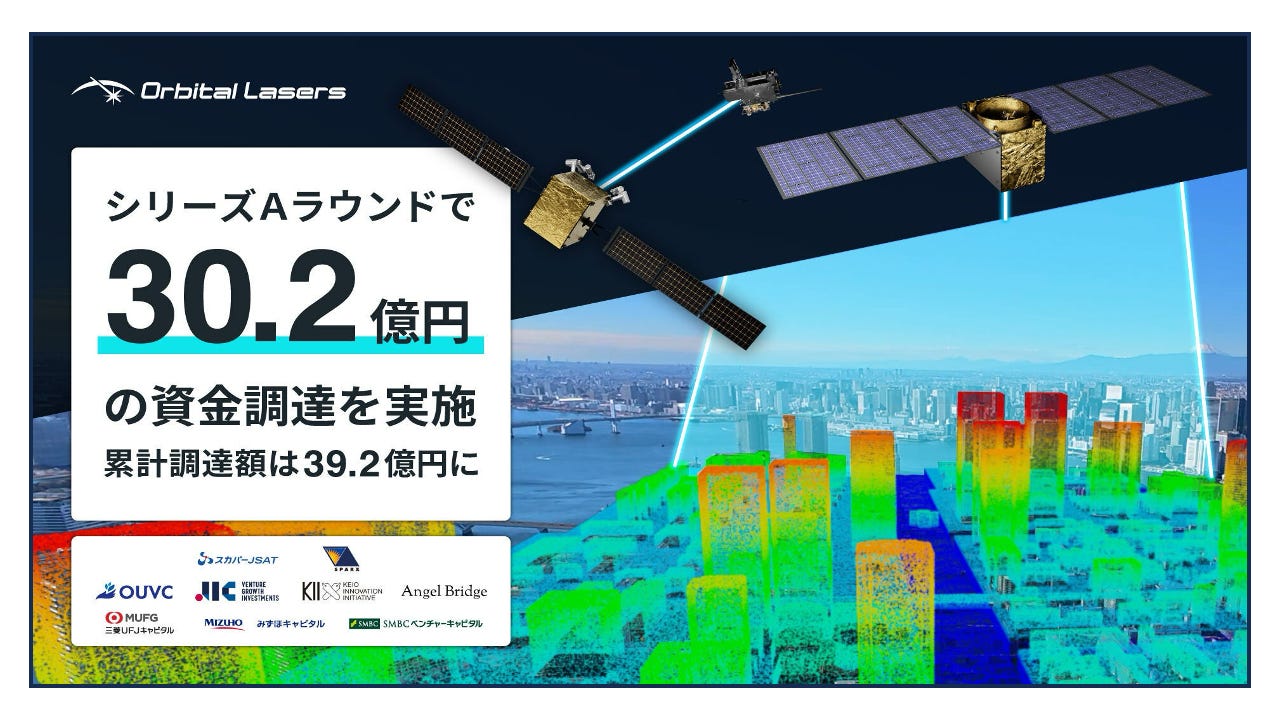
Orbital Lasers, a rising Japanese powerhouse in space optics, has successfully raised 3.02 billion yen (approx. 20 million USD) in a Series A funding round. The capital was raised through a combination of third-party allotment of shares and J-KISS stock acquisition rights.
This latest infusion brings the company’s total cumulative equity funding to 3.92 billion yen, marking a significant milestone for the startup, which spun out from satellite giant SKY Perfect JSAT just over two years ago, in January 2024.
A Blue-Chip Roster of Backers
The round saw participation from a “who’s who” of Japanese institutional and strategic investors. The syndicate includes SPARX Asset Management, JIC Venture Growth Investments, Keio Innovation Initiative (KII), Angel Bridge, and the venture arms of Japan’s three “megabanks”: Mitsubishi UFJ Capital, Mizuho Capital, and SMBC Venture Capital. Original parent company SKY Perfect JSAT also participated, reinforcing its strategic commitment to the venture.
Cutting-Edge Technology for a New Space Age
Orbital Lasers is positioning itself as a global leader in “high-power, compact, and high-efficiency” laser systems designed for the harsh environment of space. According to CEO Tadanori Fukushima, the new capital will be used to advance three core pillars of their technology stack:
Optical Transmission: High-performance laser beam delivery.
Reception Technology: High-resolution, high-sensitivity sensors and telescopes.
Satellite Bus Development: Establishing a proprietary satellite platform (in the 250kg to 500kg range) optimized for laser missions.
Commercial and Defense Applications
The company is targeting two primary commercial frontiers. First is the deployment of Satellite LiDAR, which allows for high-precision, high-frequency terrain mapping from orbit—a tool critical for disaster prevention and infrastructure monitoring. Second, and perhaps more ambitiously, the company is developing systems for the removal and control of space debris using laser technology, a growing necessity as Earth’s orbit becomes increasingly crowded.
Orbital Lasers is already seeing significant institutional traction. The company has secured research contracts with the Japan Aerospace Exploration Agency (JAXA) for LiDAR conceptual design and with the Ministry of Defense for research into satellite monitoring and defense technologies.
The Road Ahead
“By integrating these three core technologies, we will establish a technical competitive advantage that allows us to realize world-first commercial businesses,” said CEO Fukushima in a statement. The company has set an aggressive roadmap, aiming to become the dominant global leader in space optics by the 2030s.
For a company that only closed its 900-million-yen seed round in late 2024, this massive Series A highlights the intense investor appetite for space infrastructure and the strategic importance of laser technology in the burgeoning “Space Age of Discovery.”